




 Short answer
Four questions
n8n or Make: four questions, four answers
Our advice for each angle, with sources. Each card links to the section with the full numbers.
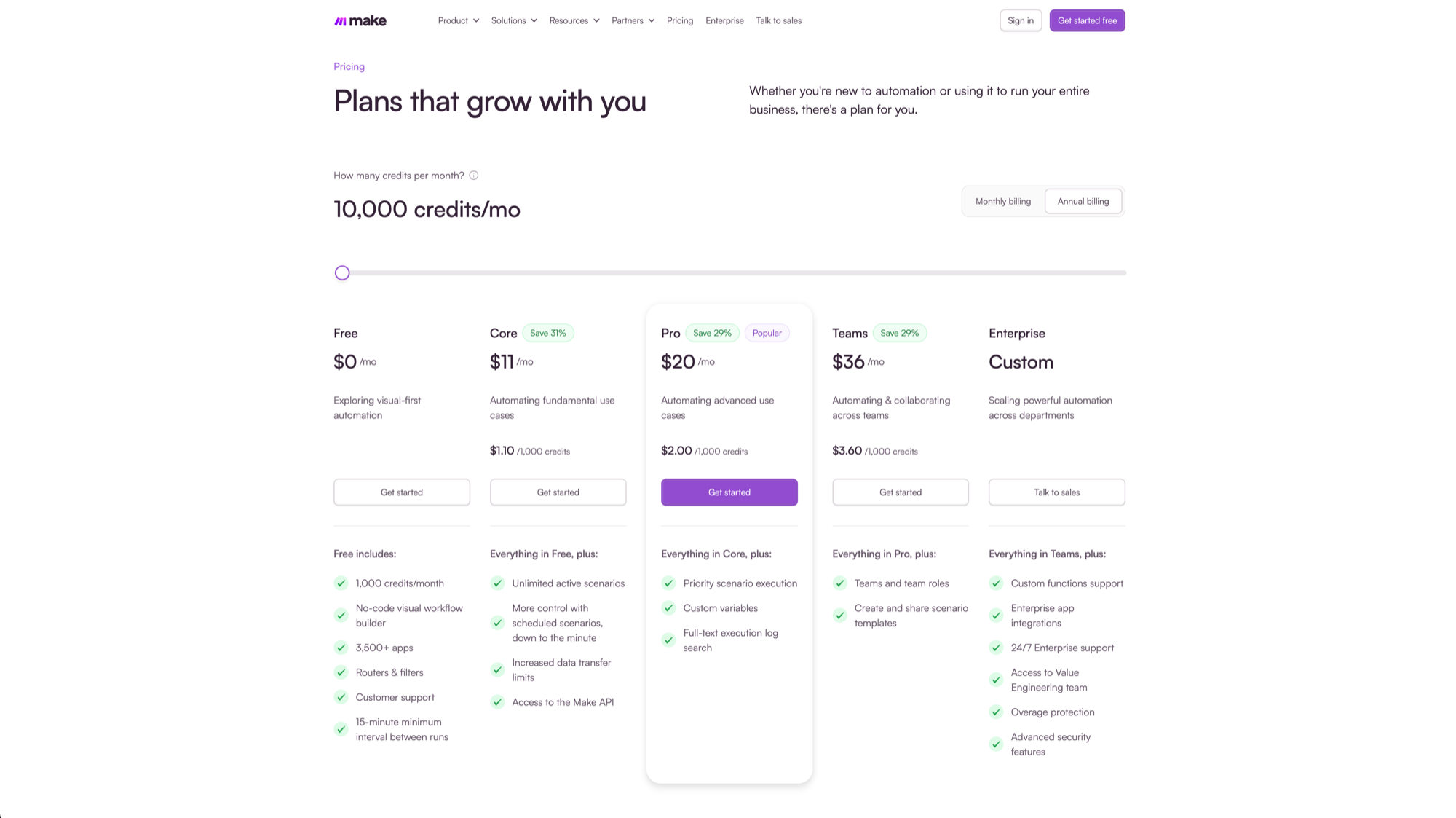
Which is cheaper?
- A five-step workflow costs n8n €24 and Make $16 a month at 1,000 runs, €60 and $81 at 10,000, and an Enterprise quote and $531 at 100,000, on monthly billing.[1, 2, 3, 4, 5, 6, 7]
- n8n publishes prices in euros, so we show them as listed and do not rank them against dollar prices.[1, 2, 3, 4, 5, 6, 7]
Which performs better?
- Make lets a run last 45 minutes, or 10 minutes on Free. n8n Cloud stops a run after 5 minutes on Starter, and after 40 minutes on Pro and Enterprise.[1, 8]
- n8n publishes concurrency: 5 runs at once on Starter, 20 to 50 on Pro and 200+ on Enterprise, and self-hosted n8n scales out with queue mode. Make measures parallel capacity in processing units but does not publish the number per plan.[1, 13, 14]
Which is more capable?
- Apps: n8n 2,000+ integrations, Make 3,500+ apps. Code steps: n8n JavaScript and Python Code node, Make JavaScript and Python on paid plans (Make Code).[4, 9, 10, 11, 12]
- AI agents: n8n, AI Agent node built on LangChain, Agents tab since n8n 2.40. Make, Make AI Agents since May 2025 (paid plans). New app with sub-agents and MCP tools since Feb 2026.[1, 15, 16, 17]
Which to choose?
- Pick n8n for long workflows, code and self-hosting. It bills one execution per run, so 10,000 runs of a 20-step workflow cost €60 a month on Pro, against $236 on Make.[1, 4, 5]
- Pick Make for short, low volume workflows and EU or US data zones with no server to run. 1,000 five-step runs cost $16 a month on Make Core against €24 on n8n Starter.[1, 4, 18]
Cost
What the same workflow costs
One trigger and four actions, run 1,000, 10,000 and 100,000 times a month, priced on the cheapest plan that fits. n8n publishes prices in euros, so those stay in euros.
| Volume | n8n | Make |
|---|---|---|
| 1,000 runs/mo | €24 monthly[1]€20/mo billed yearlyStarter, 2,500 executions | $16 monthly[4, 5]$11/mo billed yearlyCore, 10,000 credits |
| 10,000 runs/mo | €60 monthly[1]€50/mo billed yearlyPro, 10,000 executions | $81 monthly[4, 5, 6]$65/mo billed yearlyCore, 80,000 credits |
| 100,000 runs/mo | Contact sales[1, 2, 3]Yearly price not publishedEnterprise (Cloud), price on request | $531 monthly[4, 5, 7]$425/mo billed yearlyPro, 500,000 credits |
How each number was worked out
The workflow has one trigger and four actions, processes one item per run, and uses no AI or code steps. Each price is the cheapest plan whose allowance covers the volume, from the list price on the vendor pricing page.
- n8n, 1,000 runs/mo: 1,000 runs = 1,000 executions. The number of steps does not change the count.[1]
- n8n, 10,000 runs/mo: 10,000 runs = 10,000 executions. Starter is capped at 2,500 with no overage.[1]
- n8n, 100,000 runs/mo: Pro tops out at 50,000 executions (€145/mo) with no overage. n8n does not publish the Enterprise price. Third-party guides estimate €10,000 to €15,000 a year self-hosted, but the forum thread they cite contains no price, so treat it as a guess. The self-hosted Community Edition has no execution fee, but you pay for servers and upkeep.[1, 2, 3]
- Make, 1,000 runs/mo: 1,000 runs × 5 modules = 5,000 credits, with an instant (webhook) trigger. A polling trigger adds 1 credit per check.[4, 5]
- Make, 10,000 runs/mo: 10,000 runs × 5 modules = 50,000 credits. Core 40,000 and 10,000 extra credits at the 25% premium come to about $60 monthly.[4, 5, 6]
- Make, 100,000 runs/mo: 100,000 runs × 5 modules = 500,000 credits. Core stops at 300,000 credits a month.[4, 5, 7]
Discount for paying yearly
- WEXTL16.67% to 56.14%up to 56.14% off with yearly billing
- Zapier31.83% to 33.54%up to 33.54% off with yearly billing
- Make19.57% to 31.25%up to 31.25% off with yearly billing
- n8n16.67%16.67% off with yearly billing
- Activepieces16.67%16.67% off with yearly billing
Key facts
n8n vs Make: key facts
Billing, plans, apps and hosting side by side.
| Feature | n8n | Make |
|---|---|---|
| Website | n8n.io[19] | make.com[10] |
| Pricing page | n8n.io/pricing[1] | make.com/en/pricing[4] |
| Billing unit | Workflow executions[1] | Credits (operations until August 2025)[4, 5] |
| What uses a unit | 1 execution per full run, whatever the number of steps. Sub-workflows do not count[1, 20] | 1 credit per module run, triggers included, even when a polling trigger finds nothing. Routers and filters use none[5] |
| Entry paid plan | €20/mo billed yearly, €24 monthly (2,500 executions)[1] | $11/mo billed yearly, $16 monthly (10,000 credits)[4] |
| Yearly billing discount | 16.67% on every plan (the page says Save 17%)[1] | 19.57% to 31.25%, highest on Core at 10,000 credits[4] |
| Plans | Starter, Pro (Cloud), Business (self-hosted), Enterprise[1] | Free, Core, Pro, Teams, Enterprise[4] |
| No-cost option | Community Edition, self-hosted, no execution limit[3] | Free plan: 1,000 credits/mo, 2 active scenarios, 15 min interval[4] |
| Integrations | 2,000+ integrations[9] | 3,500+ apps[4, 10] |
| Hosting | n8n Cloud or self-hosted[1] | Cloud only. Enterprise runs in a separate AWS environment[21] |
| Data regions | Cloud data in Frankfurt (EU). Self-hosted: anywhere[22] | EU and US data zones[18] |
Features
Features compared
Builder, code, error handling, AI agents, MCP and team features.
| Feature | n8n | Make |
|---|---|---|
| Builder | Open node canvas[1] | Open visual canvas with modules placed anywhere[10] |
| Branching | Switch and If nodes, merge, per-item processing[1] | Router (all matching routes) and If-else with Merge[5] |
| Code steps | JavaScript and Python Code node[11] | JavaScript and Python on paid plans (Make Code)[12] |
| Error handling | Error workflows and automatic retries on all plans[1, 23] | Retry, Resume, Rollback, Break, Ignore handlers. Run replay on all plans[8, 24] |
| Versioning | Workflow history: 1 day (Starter), 5 days (Pro). Git on Enterprise or self-hosted Business[1] | Saved versions kept for 60 days[25] |
| AI agents | AI Agent node built on LangChain, Agents tab since n8n 2.40[1, 15] | Make AI Agents since May 2025 (paid plans). New app with sub-agents and MCP tools since Feb 2026[16, 17] |
| MCP | MCP Server Trigger and MCP Client node on all plans[1, 26] | Make MCP server on all plans, MCP client[27] |
| Users | Unlimited on every plan[1] | No seat limit published. Teams and roles on Teams plan[4] |
| Active workflows | Unlimited on every plan[1] | 2 on Free, unlimited on Core and up[4] |
| Templates | Public template gallery[9] | Public template gallery, shared templates on Teams[4] |
| Developer tools | Custom nodes in TypeScript, REST API, CLI[1] | Custom apps, REST API, TypeScript SDK, Make CLI[4] |
Limits and ratings
Run limits and ratings
Neither vendor publishes speed or uptime figures we could check, so this compares the limits each one publishes and what users say on review sites.
| Feature | n8n | Make |
|---|---|---|
| Max run time | 5 min on Starter, 40 min on Pro and Enterprise (Cloud)[1] | 45 minutes (10 minutes on Free)[8] |
| Shortest schedule | Not limited by plan[1] | 15 min on Free, down to 1 minute on paid plans[4, 28] |
| Concurrent runs | 5 on Starter, 20 to 50 on Pro, 200+ on Enterprise[1] | Parallel capacity in processing units, per-plan numbers not published[14] |
| Error recovery | Error workflows and automatic retries on all plans[1, 23] | Retry, Resume, Rollback, Break, Ignore handlers. Run replay on all plans[8, 24] |
Longest run a single workflow can take
- WEXTL24 hours
- Make45 min
- n8n Cloud40 min
- Activepieces10 min
| Review site | n8n | Make |
|---|---|---|
| G2 | 4.7/5 (328 reviews)[29] | 4.6/5 (524 reviews)[32] |
| Capterra | 4.6/5 (48 reviews)[30] | 4.8/5 (406 reviews)[33] |
| Trustpilot | 2.9/5 (50 reviews)[31] | 2.3/5 (177 reviews)[34] |
In depth
n8n vs Make in depth
Per module or per run
Make charges 1 credit for every module run, the trigger included. A polling trigger uses 1 credit for each check, even when it finds nothing. Routers and filters use none. n8n counts one execution for each run of the whole workflow, whatever the number of steps, and sub-workflow runs do not count. A trigger that polls Make every minute makes up to 43,200 checks in a 30-day month (30 × 1,440), more than the 40,000 credits of that Core tier before any run does real work. Use an instant webhook trigger on Make where the app offers one.[1, 4, 5, 20, 28]
A five-step workflow with an instant trigger uses 5 Make credits per run and 1 n8n execution. n8n lists prices in euros and Make in dollars, and we show both as listed. At 1,000 runs Make Core costs $16 a month ($11 billed yearly) and n8n Starter €24 (€20 yearly). At 10,000 runs Make Core with 80,000 credits costs $81 ($65 yearly) and n8n Pro €60 (€50 yearly). Make Core with 40,000 credits and 10,000 extra credits comes to about $60, close to the n8n figure. At 100,000 runs Make Pro with 500,000 credits costs $531 ($425 yearly). n8n Cloud has no published price at that volume: Pro tops out at 50,000 executions for €145 a month, and more means Enterprise and a sales call.[1, 4, 5, 6, 7]
The step count changes the picture. Take a 20-step workflow, 1 trigger and 19 actions. On Make each run uses 20 credits. At 1,000 runs that is 20,000 credits, $28 a month on Core ($20 yearly), against €24 on n8n. At 10,000 runs it is 200,000 credits. The 150,000 tier is too small, so the bill is $236 a month on the 300,000 tier ($189 yearly). n8n Pro stays at €60. Self-hosted n8n has no execution fee at all. The n8n guide for Hetzner says the CPX11 server is enough for most usage, listed at €17.99 a month before VAT, and the time to update and secure it.[1, 3, 4, 5, 35, 36]
Building, code and debugging
Both tools draw workflows on an open canvas. Make places modules anywhere and splits a flow with a Router, which runs every route that matches, or with If-else and Merge. n8n runs each node once for every item it receives, so a list flows through without a separate loop step, and If and Switch nodes branch.[1, 5, 10, 11]
Both accept JavaScript and Python in code steps. Make Code needs a paid plan, runs for at most 30 seconds and uses 2 credits for every second it runs. The n8n Code node is on every plan and sits inside the one execution, so it adds nothing to the bill. Self-hosted n8n also takes custom nodes written in TypeScript.[1, 5, 11, 12]
Make has the deeper error toolbox: Retry, Resume, Rollback, Break and Ignore handlers, and run replay on every plan. n8n lets each workflow name an error workflow that runs when an execution fails, and automatic retries are on all plans. Make keeps saved versions for 60 days. n8n Cloud keeps workflow history for 1 day on Starter and 5 days on Pro, and Git version control needs Enterprise on Cloud or the self-hosted Business plan.[1, 8, 23, 24, 25]
Run limits, schedules and scale
Make stops a run after 45 minutes, or 10 minutes on Free. n8n Cloud stops a run after 5 minutes on Starter, and after 40 minutes on Pro and Enterprise. A data job of 20 minutes fits on Make Core and fails on n8n Starter. Make schedules run down to every minute on paid plans and every 15 minutes on Free. n8n does not limit the schedule interval by plan.[1, 4, 8, 28]
n8n publishes concurrency: 5 runs at once on Starter, 20 to 50 on Pro and 200+ on Enterprise. Make added a parallel capacity limit in 2026, measured in processing units, where a typical run takes one unit. It does not publish the number per plan. Self-hosted n8n scales with queue mode: a main instance takes triggers and webhooks, Redis queues the executions, and you add workers. The n8n docs include queue mode in the Community Edition.[1, 3, 13, 14]
AI agents and MCP
n8n has an AI Agent node built on LangChain on every plan, and an Agents tab since n8n 2.40 in September 2026. An AI step is one more node in the run, so it does not add executions. Make AI Agents are on paid plans, with sub-agents and MCP tools since February 2026. Steps that use the Make AI Provider cost 1 credit and add credits for the tokens.[1, 5, 15, 17]
Both work with MCP. n8n has an MCP Server Trigger and an MCP Client node on all plans. Make runs an MCP server on all plans and has an MCP client. Watch the data region with AI on Make: it warns that some AI features route to the US or UK from EU zones.[1, 18, 26, 27]
Hosting, compliance and reviews
Make is cloud only, with EU and US data zones. Enterprise runs in a separate AWS environment, and an on-premise agent can reach local apps, but Make itself does not run on your servers. It publishes SOC 2 Type II and SOC 3 audits, and ISO 27001 on Enterprise. SSO is on Enterprise.[18, 21]
n8n Cloud stores data in Frankfurt. You can also run n8n with Docker, npm or Helm, and air-gapped on Enterprise. The code is source available under the Sustainable Use License, which allows internal business use but is not OSI open source. n8n lists SOC 2 Type 2 and GDPR. SSO needs Enterprise on Cloud or Business when self-hosted.[1, 3, 22, 37, 38]
Make has run since 2015 as Integromat and belongs to Celonis. n8n was founded in Berlin in 2019, has raised $240 million and has more than 212,000 GitHub stars. Make scores 4.6 on G2 from 524 reviews, 4.8 on Capterra from 406 and 2.3 on Trustpilot from 177. n8n scores 4.7 on G2 from 328 reviews, 4.6 on Capterra from 48 and 2.9 on Trustpilot from 50.[19, 29, 30, 31, 32, 33, 34, 39, 40]
What we see at StartAutomate
n8n runs 25% of the client automations we build and maintain, and Make runs 15%. Our n8n share grew every year from 2024 to 2026, and our Make share declined.[41]
We pick Make when a client needs fast iteration at low scale, and our smallest clients, with 1 to 5 people, are mostly on Make. We pick n8n when workflows need heavy IT tooling, which usually means larger IT companies, often with 300+ employees. Every automation runs in the account of the client, who owns the workflows, the credentials and the bill.[41]
Our largest single case was an IT company running about 1 million Make operations a month. We moved it to n8n before WEXTL existed. Today we would move a client like that to WEXTL.[41]
Pros and cons
Strengths and weaknesses
Each point links to its source. WEXTL is listed with the same detail as the others.
n8n
Strengths of n8n
- Billed per run, not per step, so long workflows cost the same as short ones.[1]
- Self-hosting with Docker, npm or Helm, and a Community Edition with no execution limit.[3]
- Code nodes in JavaScript and Python.[11]
- The largest open community here: 212,000+ GitHub stars.[19]
- Unlimited users and active workflows on every plan.[1]
Weaknesses of n8n
- No published Cloud price above 50,000 executions a month. Higher volumes go to Enterprise sales, and third-party guesses for Enterprise run €10,000 to €15,000 a year.[1, 2]
- Git, environments and SSO need Enterprise on Cloud.[1]
- The Sustainable Use License limits commercial redistribution. It is not OSI open source.[38]
- Self-hosting means you run the servers, updates, backups and security.[3, 13]
- A run on Starter stops after 5 minutes.[1]
- Version upgrades are your job. We find that migrating the workflows falls on you each time n8n ships a new version. The n8n release notes say n8n 3.0 drops npm installs.[15, 41]
Make
Strengths of Make
Weaknesses of Make
- Every module uses credits, the trigger included. A polling trigger uses 1 credit per check even when it finds nothing.[5]
- A run stops after 45 minutes (10 minutes on Free).[8]
- Extra credits cost 25% more than plan credits, and Core stops at 300,000 credits a month.[6, 7]
- No self-hosting.[21]
- Code steps need a paid plan and use 2 credits per second of run time.[5, 12]
- We find that Make steers clients to Enterprise above about 1 million operations a month, with quotes from about $50,000 a year. The Pro list price for 1 million credits is $969 a month, or $11,628 a year.[4, 41]
From our client work
What our client work shows
How StartAutomate splits client automations, when we pick n8n or Make, and what we see building and maintaining them.
First-hand data from the StartAutomate team, November 2026. It covers the automations we build and maintain for clients, not the market as a whole.[41]
Where our client automations run
- WEXTL30%
- n8n25%
- Zapier18.75%
- Make15%
- Activepieces6.25%
- Claude workflows5%
How the split changed, 2024 to 2026
- Make45% → 15%−30% percentage points, fell
- Zapier30% → 18.75%−11.25% percentage points, fell
- Activepieces10% → 6.25%−3.75% percentage points, fell
- n8n15% → 25%+10% percentage points, grew
- WEXTL0% → 30%+30% percentage points, grew
- Claude workflows0% → 5%+5% percentage points, grew
View as table
| Platform | 2024 | 2025 | 2026 |
|---|---|---|---|
| Make | 45% | 38% | 15% |
| Zapier | 30% | 27.75% | 18.75% |
| Activepieces | 10% | 9.25% | 6.25% |
| n8n | 15% | 22% | 25% |
| WEXTL | 0% | 1% | 30% |
| Claude workflows | 0% | 2% | 5% |
Credits per order on the same live workflow
- WEXTL9 to 11
- Make16 or more
When we pick each one
- Make
- We pick it when the client needs fast iteration at low scale. Our smallest clients, with 1 to 5 people, are mostly on Make.
- n8n
- We pick it for workflows that need heavy IT tooling, which usually means larger IT companies, often with 300+ employees.
What it costs in practice
- Credits per order on that workflow: Make uses at least 16, WEXTL uses 9 to 11, depending on which conditions pass. At 5,000 orders a month that is at least 80,000 Make credits, which needs Core 80k or higher, from $81 monthly ($65 billed yearly), against at most 55,000 WEXTL credits, which fits Grow at $40 monthly ($33.33 billed yearly). WEXTL wins on both ends: fewer credits per run and a lower price per credit.
- Make steers clients toward Enterprise above about 1 million operations a month, and the quotes we have seen start from about $50,000 a year. The Pro list price for 1 million credits is $969 a month, or $11,628 a year.
- Our Make clients have hit all three Make limits in real work: the 45-minute run cap, the 300,000-credit ceiling on Core, and the 25% premium on extra credits.
- Empty polls cost the same on Make and WEXTL: each check uses a credit, even when it finds nothing. The WEXTL saving on that workflow comes from fewer steps per run and a lower price per credit, not from polling.
Building and handing over
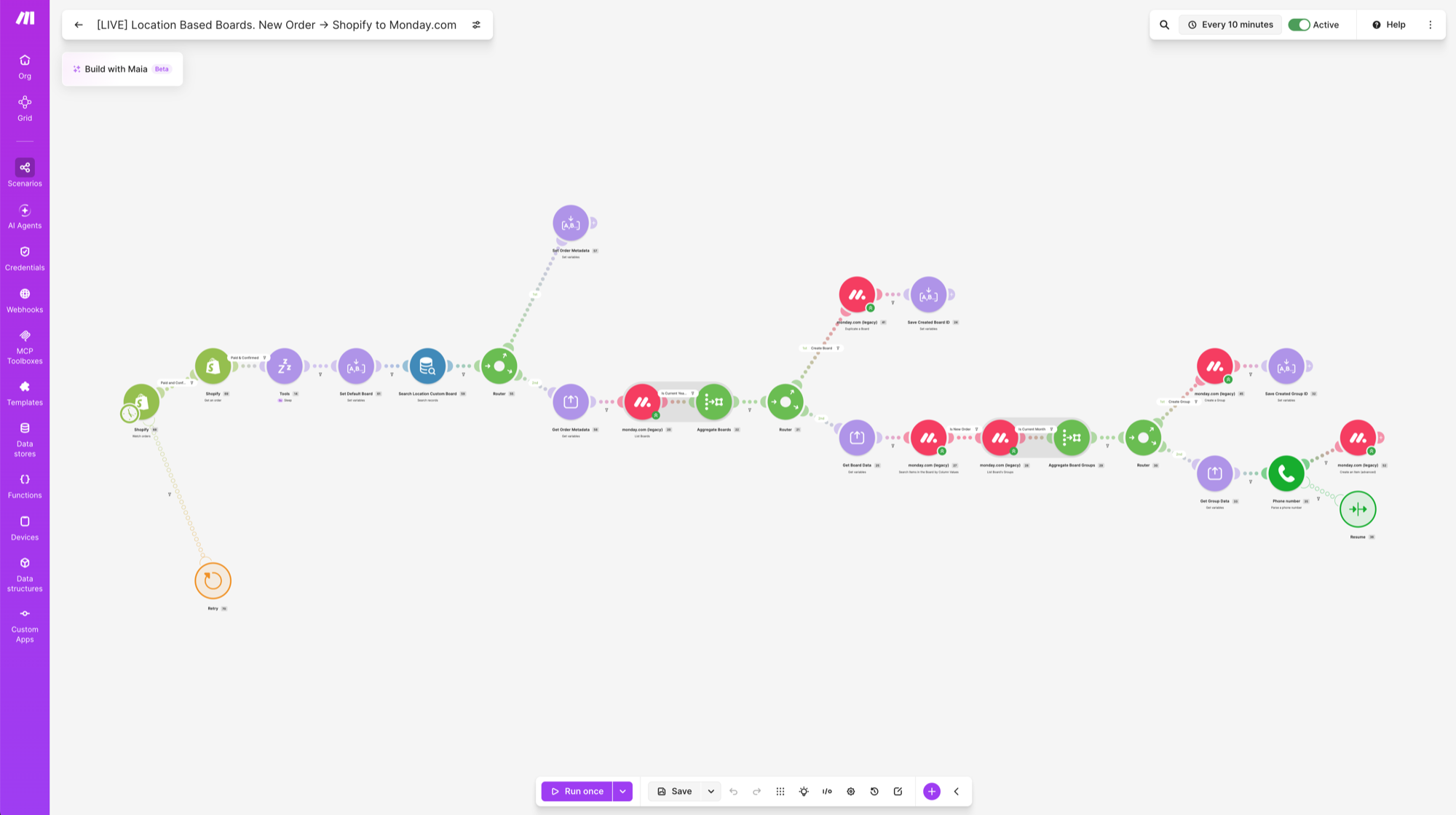
- The Shopify to Monday.com workflow we run on both Make and WEXTL took us about the same time to build and stabilize on Make as on WEXTL. On n8n it would take more effort. On Zapier we would not recommend it to the client at all.
- The same logic adds more steps on Make (routers, set and get variable modules, aggregators). We find the WEXTL version easier to read and hand over.
- WEXTL feels as capable as n8n to us, and its JS Code node runs with libraries. We still build load-heavy and script-heavy workflows for IT teams on n8n: those teams are more technical, n8n has more of the low-code tools they use, many of them already run their own scripts, and we want to keep the option of self-hosting open for them.
What breaks and how it gets fixed
- API rate limits and timeouts are rarely a problem for us on n8n, Make or WEXTL, because each has retry handling for them.
- Make and WEXTL keep their connector code closed, so only the platform team can update a connector. Make has the older catalog, and in our experience some of its connectors lag behind the API of the app, so a fix can take time. The HTTP step is the workaround. We have also found that some apps on WEXTL come with more modules than the same app on Make.
- A client came to us when the YOURLS app on Make stopped working after an update: its endpoint had gained a stray slash at the end. The client did not want to wait for a fix and wanted a reusable app rather than an HTTP step, so we built a custom Make app for it.
- Connectors on n8n and Activepieces are open source, so a fix depends on review and community work. On Activepieces we have found that upkeep varies from piece to piece.
Maintenance load we see
- n8n gives us the most failures and the most maintenance work, because it carries the most complexity. It is closer to low code than no code, so we plan for upkeep from the start. Migrating the workflows is left to us and the client each time n8n releases a new version. That is why we keep n8n for very technical teams.
- Make starts to hit limits once workflows scale.
Our notes on credentials, connector upkeep, volumes, clients and moving between platforms apply to all five platforms. Read them on the platform overview →
Screenshots
Inside the builders
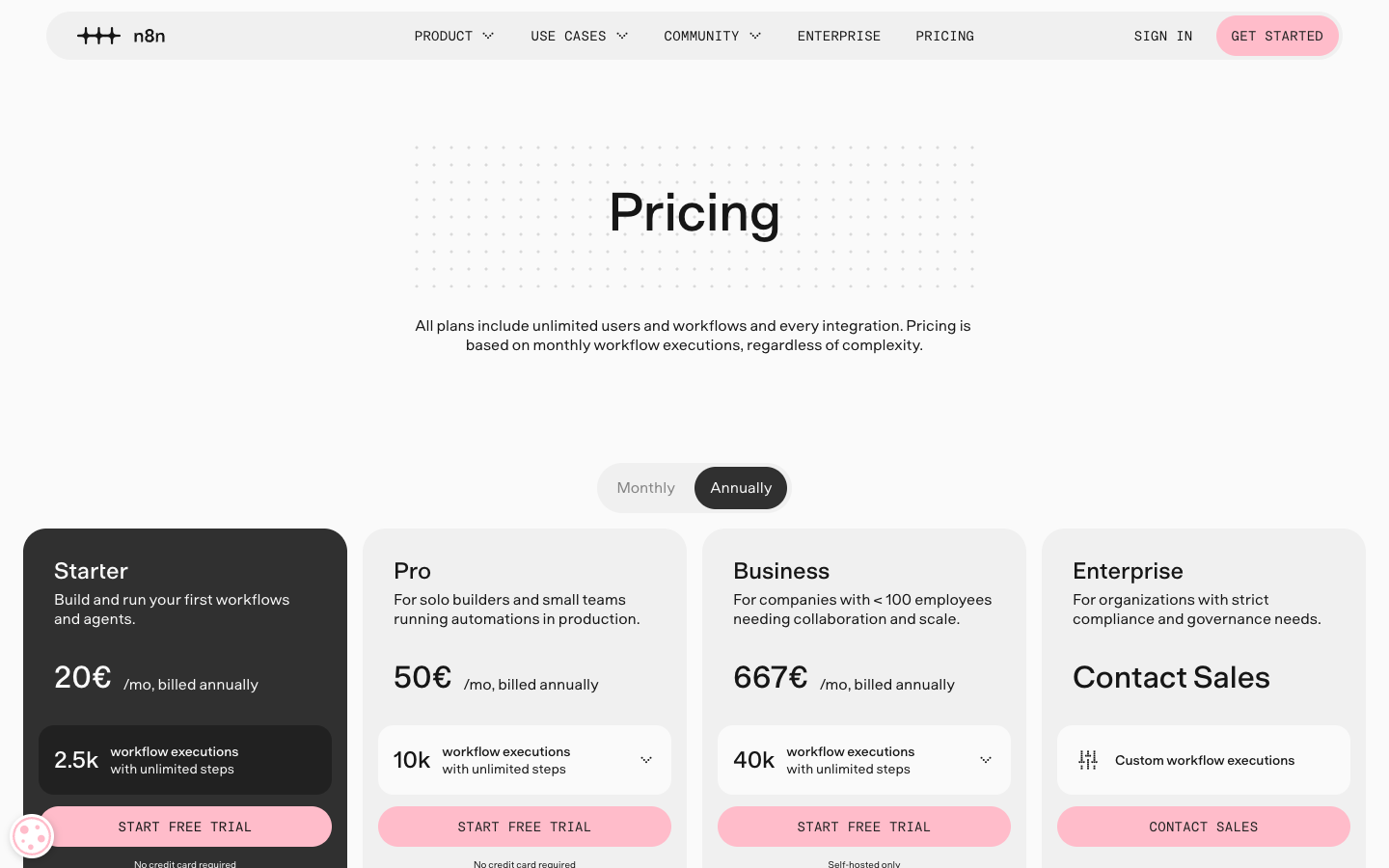
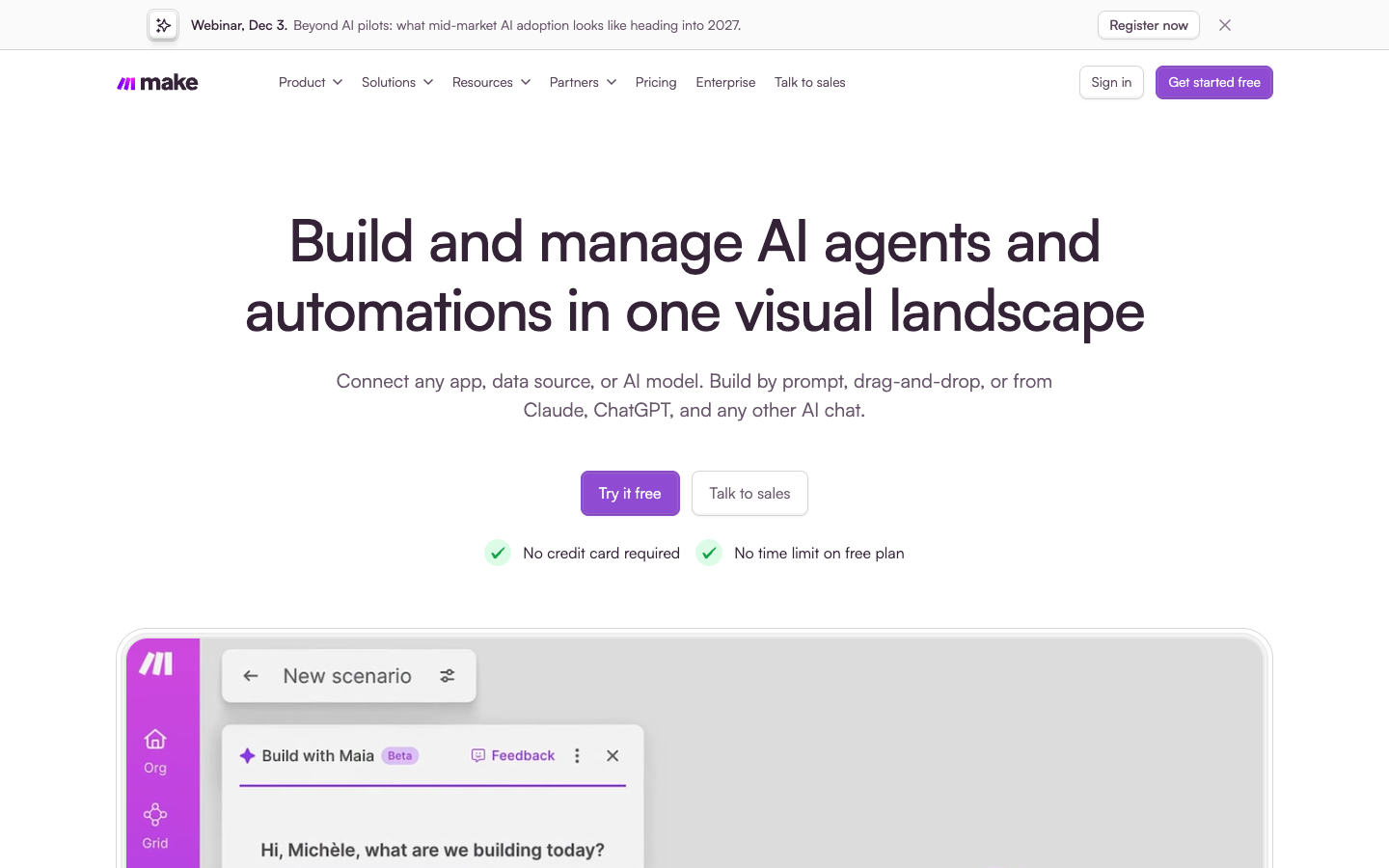
Client workflows in each editor, then the vendor websites as we saw them.
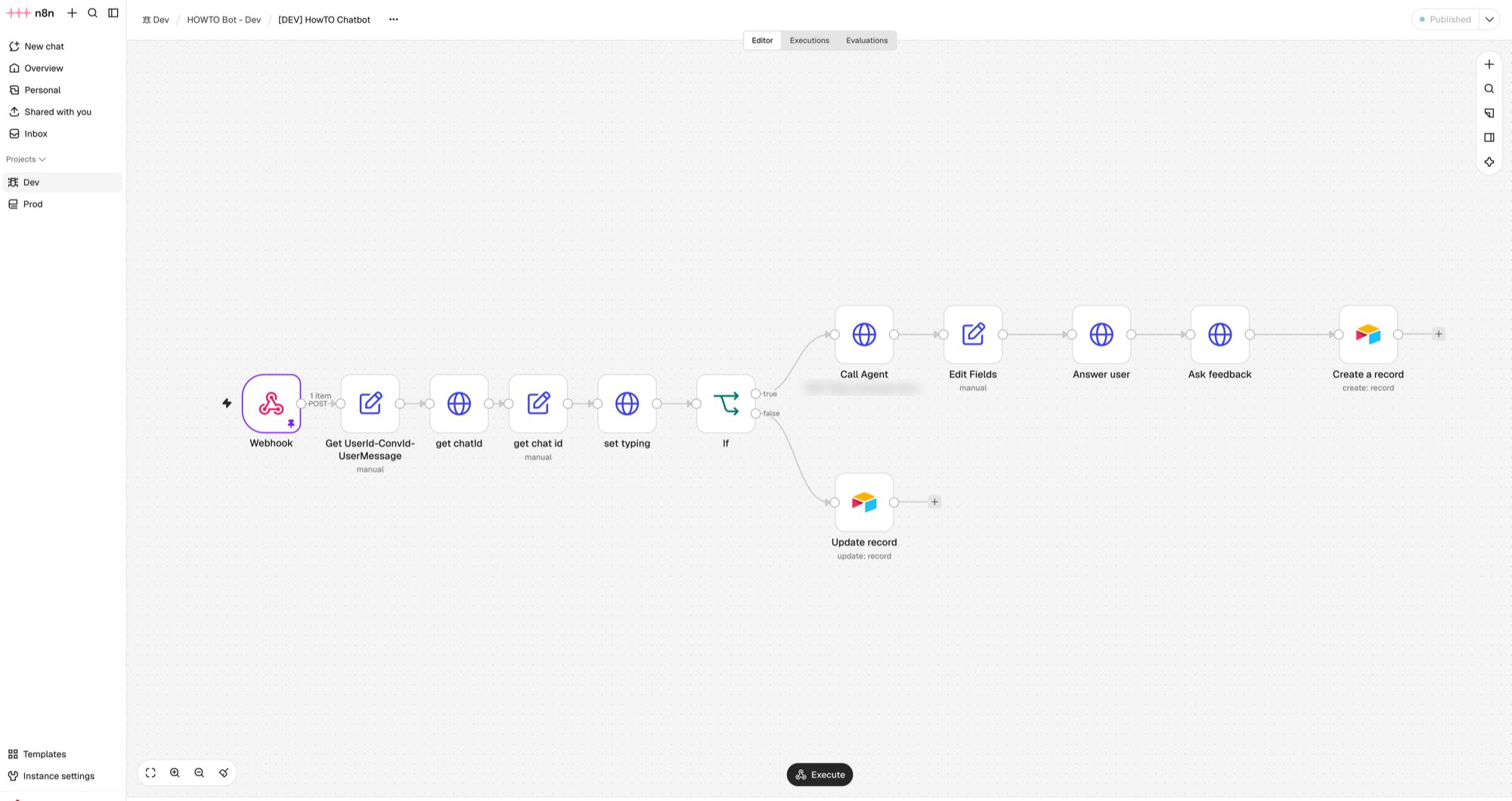
Workflows built by StartAutomate, with names blurred. The Make shot shows a live workflow that files each new paid Shopify order on a Monday.com board for its location. We also run it on WEXTL. See both builders side by side → The n8n shot shows a client chatbot workflow, with the client address blurred.
Company and compliance
Company, hosting and compliance
| Feature | n8n | Make |
|---|---|---|
| Founded | 2019, by Jan Oberhauser[40] | Integromat in 2015 (per Make), renamed Make in 2022[39] |
| Headquarters | Berlin, Germany[40] | Prague, Czech Republic[39] |
| Company and track record | $240M raised, valued at $5.2B in May 2026[40] | Part of Celonis, 380+ employees[39] |
| Self-hosting | Yes: Docker, npm, Helm, air-gapped on Enterprise[3, 37] | No. An on-premise agent can reach local apps[21] |
| Source code | Source available under the Sustainable Use License, not OSI open source[38] | Closed source[39] |
| Compliance | SOC 2 Type 2, GDPR[22, 37] | SOC 2 Type II, SOC 3, GDPR. ISO 27001 on Enterprise[21] |
| SSO | Enterprise on Cloud, Business on self-hosted[1] | SAML and OIDC SSO on Enterprise[21] |
Verdict
Which one to pick
n8n: who should choose it
Pick n8n for long workflows, code-heavy builds and self-hosting.
- Your workflows have many steps. n8n bills one execution per run, so 10,000 runs of a 20-step workflow cost €60 a month on Pro, while Make needs 200,000 credits at $236.
- You want to self-host, or your security team wants the data on your own servers. The Community Edition has no execution fee.
- You write code steps. Code nodes run on every n8n plan and do not add to the bill, while Make Code needs a paid plan, stops at 30 seconds and uses 2 credits per second.
- You need published concurrency: 20 to 50 runs at once on Pro and 200+ on Enterprise. Make does not publish its parallel capacity per plan.
Make: who should choose it
Pick Make for low bills on short workflows, data zones without a server, and the larger catalog.
- Your workflows are short and your volume is low. 1,000 five-step runs cost $16 a month on Make Core against €24 on n8n Starter.
- Nobody on the team will run a server, and you want to choose between EU and US data zones. n8n Cloud stores data in Frankfurt.
- An app you need has a Make module but no n8n node (3,500+ apps against 2,000+).
- Single runs take up to 45 minutes, or you want saved versions kept for 60 days. n8n Starter stops a run after 5 minutes and keeps 1 day of workflow history.
FAQ
Frequently asked questions
Short answers on n8n and Make, each with its source.
Is n8n cheaper than Make?
Can I self-host Make like n8n?
Does n8n charge for every step like Make?
Keep comparing
More comparisons



Sources
Sources
Every source was read on the date shown. 41 sources in total.
- Plans and pricing. n8n. Accessed 28 November 2026. Prices shown in EUR.
- n8n Enterprise self-hosted deployment cost guide. Branch8. Accessed 28 November 2026. Third-party estimate, not a quote. The n8n forum thread it cites contains no price.
- Community edition features. n8n Docs. Accessed 28 November 2026.
- Pricing. Make. Accessed 28 November 2026. Prices shown in USD. Make may localize prices by region.
- How features use credits. Make Help Center. Accessed 28 November 2026.
- Extra credits. Make Help Center. Accessed 28 November 2026.
- Adjustments to plans and pricing. Make Help Center. Accessed 28 November 2026.
- Fix errors and warnings. Make Help Center. Accessed 28 November 2026.
- Integrations. n8n. Accessed 28 November 2026.
- Make home page. Make. Accessed 28 November 2026.
- Code node. n8n Docs. Accessed 28 November 2026.
- The Make Code app is available. Make Help Center. Accessed 28 November 2026.
- Queue mode. n8n Docs. Accessed 28 November 2026.
- Parallel capacity. Make Help Center. Accessed 28 November 2026.
- Release notes. n8n Docs. Accessed 28 November 2026.
- Make AI Agents: the next step in automation. Make Help Center. Accessed 28 November 2026.
- Meet the new Make AI Agents app. Make Help Center. Accessed 28 November 2026.
- AI providers and data zones. Make Help Center. Accessed 28 November 2026.
- n8n repository. GitHub. Accessed 28 November 2026.
- Sub-workflows. n8n Docs. Accessed 28 November 2026.
- Security. Make. Accessed 28 November 2026.
- Security. n8n. Accessed 28 November 2026.
- Error handling. n8n Docs. Accessed 28 November 2026.
- Scenario run replay. Make Help Center. Accessed 28 November 2026.
- Scenario version control. Make Help Center. Accessed 28 November 2026.
- MCP Server Trigger. n8n Docs. Accessed 28 November 2026.
- Make MCP server. Make Help Center. Accessed 28 November 2026.
- Schedule a scenario. Make Help Center. Accessed 28 November 2026.
- n8n reviews. G2. Accessed 28 November 2026. Read from a search snippet, G2 blocked the direct request.
- n8n reviews. Capterra. Accessed 28 November 2026. Read from a search snippet.
- n8n reviews. Trustpilot. Accessed 28 November 2026.
- Make reviews. G2. Accessed 28 November 2026.
- Make reviews. Capterra. Accessed 28 November 2026. Read from a search snippet, the site showed a CAPTCHA.
- Make reviews. Trustpilot. Accessed 28 November 2026.
- Hosting n8n on Hetzner. n8n Docs. Accessed 28 November 2026.
- Cloud regular performance plans. Hetzner. Accessed 28 November 2026.
- Enterprise. n8n. Accessed 28 November 2026.
- LICENSE.md. GitHub. Accessed 28 November 2026.
- About Make. Make. Accessed 28 November 2026.
- Press. n8n. Accessed 28 November 2026.
- StartAutomate client work, 2019 to 2026. StartAutomate, first-hand data.