


 Short answer
Key facts
Activepieces: key facts
Billing, plans, apps and hosting.
| Feature | Activepieces |
|---|---|
| Website | activepieces.com[3] |
| Pricing page | activepieces.com/pricing[2] |
| Billing unit | Credits[2] |
| What uses a unit | 1 credit per run, whatever the number of steps. AI steps add credits. Empty polls use none[2, 3] |
| Entry paid plan | $20/mo (10,000 credits)[2] |
| Yearly billing discount | 16.67% (Save 2 months). Yearly prices not shown[2] |
| Plans | Free, Plus, Team, Ultimate, Embed[2] |
| No-cost option | Free plan: 1,000 credits/mo. Self-hosted Community Edition with no cap[2] |
| Integrations | 778 pieces[4] |
| Hosting | Cloud or self-hosted[2] |
| Data regions | Cloud in Frankfurt by default. Self-hosted: anywhere[5] |

Overview
Activepieces in depth
How Activepieces works
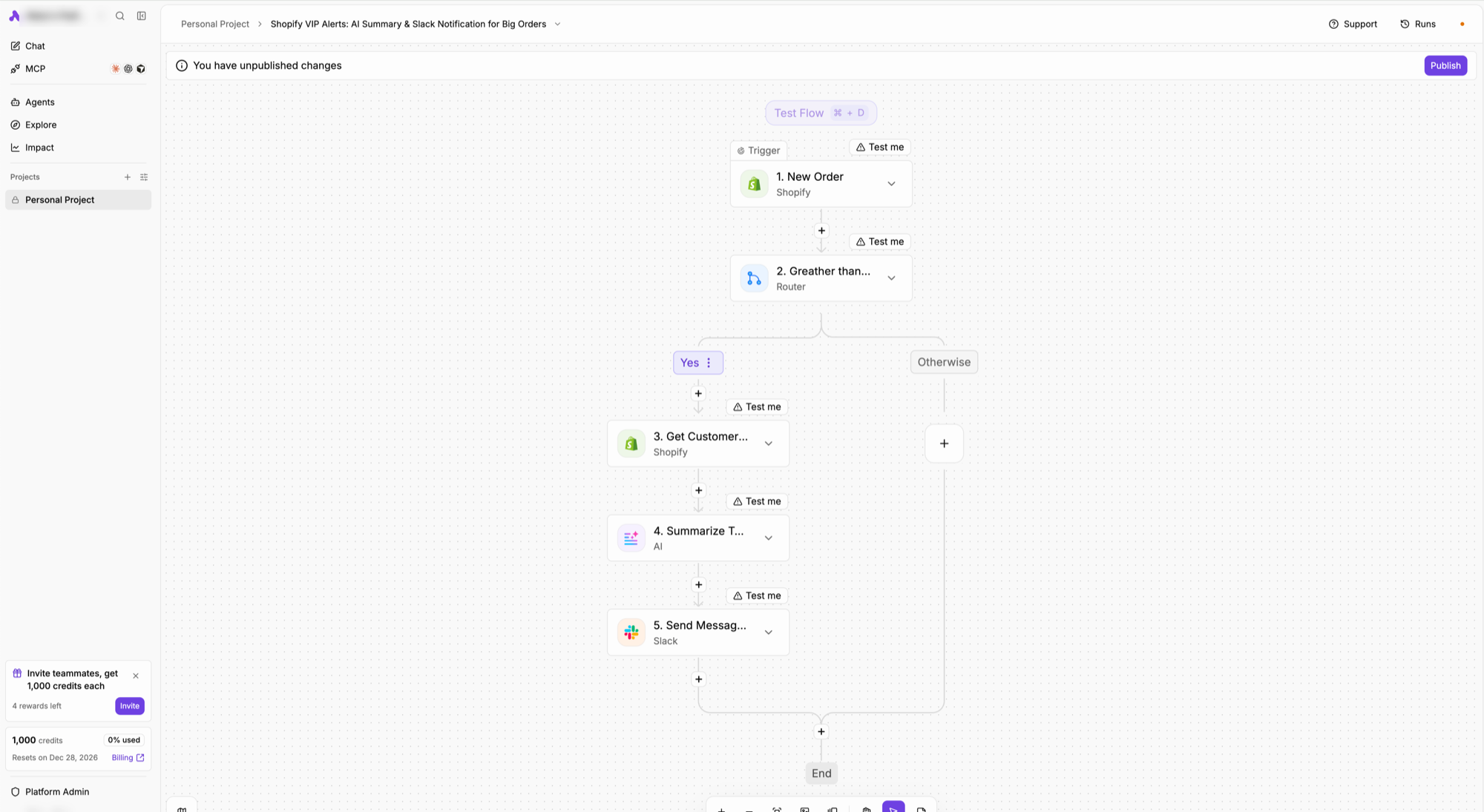
Activepieces builds flows as a tree of steps. You add a step with the + button between two steps or inside a router branch or a loop. Code steps use TypeScript. Integrations are called pieces, and the catalog lists 778 of them.[3, 4]
The company went through Y Combinator in Summer 2022. Its community edition is MIT licensed, and enterprise features sit in a separate folder under a commercial license.[1, 6]
What you pay for
One run is one credit, however many steps it has. Branches, loops and code do not change the count, and a polling trigger that finds nothing uses no credit. AI steps add credits for the model call. The Free plan has 1,000 credits, Plus costs $20 for 10,000, and Team costs $200 for 50,000. Extra credits cost $0.007 each.[2, 3]
Many articles still quote older Activepieces prices of $5 per flow or a $25 plan. The pricing page we checked on 28 November 2026 showed the credit plans above.[2]
Where it falls short
The catalog has 778 pieces, fewer than the other four, so check that every app you need has a piece. Cloud runs stop after 10 minutes. The security page says SOC 2 Type 2, while a November 2026 Activepieces blog post says the SOC 2 programme is still in progress, so ask for the report before you rely on it.[4, 5, 7, 8]
Cost
What a five-step workflow costs
One trigger and four actions, run 1,000, 10,000 and 100,000 times a month, on the cheapest plan that fits.
| Volume | Activepieces |
|---|---|
| 1,000 runs/mo | $0 monthly[2]Yearly price not publishedFree, 1,000 credits |
| 10,000 runs/mo | $20 monthly[2]Yearly price not publishedPlus, 10,000 credits |
| 100,000 runs/mo | $550 monthly[2, 8]Yearly price not publishedTeam, 50,000 credits and overage |
How each number was worked out
The workflow has one trigger and four actions, processes one item per run, and uses no AI or code steps. Each price is the cheapest plan whose allowance covers the volume, from the list price on the vendor pricing page.
- Activepieces, 1,000 runs/mo: 1,000 runs = 1,000 credits, exactly the Free plan cap. Run 1,001 waits for next month, so Plus at $20 gives room.[2]
- Activepieces, 10,000 runs/mo: 10,000 runs = 10,000 credits, exactly the Plus allowance. Each extra run costs $0.007.[2]
- Activepieces, 100,000 runs/mo: $200 + (100,000 − 50,000) × $0.007 = $550. Plus with overage would be $650.[2, 8]
Discount for paying yearly
- WEXTL16.67% to 56.14%up to 56.14% off with yearly billing
- Zapier31.83% to 33.54%up to 33.54% off with yearly billing
- Make19.57% to 31.25%up to 31.25% off with yearly billing
- n8n16.67%16.67% off with yearly billing
- Activepieces16.67%16.67% off with yearly billing
Features
Features
Builder, code, error handling, AI agents, MCP and team features.
| Feature | Activepieces |
|---|---|
| Builder | Step-by-step tree builder[3] |
| Branching | Routers and loops[3] |
| Code steps | TypeScript[3] |
| Error handling | Retries, error handling, resume from last checkpoint[3] |
| Versioning | Draft and publish versions. Git Sync on Ultimate[2, 9] |
| AI agents | Agents with tools, reusable agents since Sep 2026[10] |
| MCP | Built-in MCP server, every piece exposed as a tool[11] |
| Users | 5 on Free and Plus, 25 on Team[2] |
| Active workflows | Unlimited flows[2] |
| Templates | Public template gallery[4] |
| Developer tools | Pieces CLI in TypeScript, REST API on paid plans[2] |
Limits and ratings
Run limits and ratings
Longest run a single workflow can take
- WEXTL24 hours
- Make45 min
- n8n Cloud40 min
- Activepieces10 min
| Review site | Activepieces |
|---|---|
| G2 | 4.8/5 (142 reviews)[12] |
| Capterra | No listing found |
| Trustpilot | 4.3/5 (131 reviews)[13] |
Pros and cons
Strengths and weaknesses of Activepieces
Each point links to its source.
Activepieces
Strengths of Activepieces
- One credit per run, however many steps, branches or loops the flow has.[3]
- An MIT-licensed community edition you can self-host with no run cap.[2, 6]
- The best review scores here: 4.8 on G2 and 4.3 on Trustpilot.[12, 13]
- Every piece is exposed as an MCP tool.[11]
- A polling trigger that finds nothing uses no credits.[3]
Weaknesses of Activepieces
- The smallest catalog here: 778 pieces.[4]
- Code steps support TypeScript only.[3]
- A Cloud run stops after 10 minutes.[7]
- Its own pages disagree on SOC 2: audited on the security page, in progress on the November 2026 blog.[5, 8]
- Git Sync, audit logs and custom roles need the Ultimate plan, priced on request.[2]
From our client work
What our client work shows
Where Activepieces sits in the client automations StartAutomate builds and maintains.
First-hand data from the StartAutomate team, November 2026. It covers the automations we build and maintain for clients, not the market as a whole.[14]
Where our client automations run
- WEXTL30%
- n8n25%
- Zapier18.75%
- Make15%
- Activepieces6.25%
- Claude workflows5%
How the split changed, 2024 to 2026
- Make45% → 15%−30% percentage points, fell
- Zapier30% → 18.75%−11.25% percentage points, fell
- Activepieces10% → 6.25%−3.75% percentage points, fell
- n8n15% → 25%+10% percentage points, grew
- WEXTL0% → 30%+30% percentage points, grew
- Claude workflows0% → 5%+5% percentage points, grew
View as table
| Platform | 2024 | 2025 | 2026 |
|---|---|---|---|
| Make | 45% | 38% | 15% |
| Zapier | 30% | 27.75% | 18.75% |
| Activepieces | 10% | 9.25% | 6.25% |
| n8n | 15% | 22% | 25% |
| WEXTL | 0% | 1% | 30% |
| Claude workflows | 0% | 2% | 5% |
When we pick each one
- Activepieces
- We pick it only when the client already runs on Activepieces.
What it costs in practice
- We estimate the running cost on each suitable platform up front after a strategy session, with the pros and cons of each, and recommend one platform for each workflow based on its use case. The client makes the final choice, and usually goes with our recommendation.
Building and handing over
- We only build on Activepieces for clients who already use it. Clients outgrow it on deterministic workflows at a point close to Zapier: it comes with complexity.
- Handover to the client team is easier on Make, WEXTL, Activepieces and Zapier. n8n is the hardest to hand over: we document every n8n workflow in detail, all the more because we mostly use n8n for heavy workflows.
- We build that workflow on the platform with a ready connector for the app when the others lack one, which keeps the build simple. Failing that, we call its API with the HTTP step, which all five platforms have. We build our own connectors, such as private Make custom apps, only in rare cases: a custom connector needs its own upkeep, and the client pays for that work.
What breaks and how it gets fixed
- Expired or revoked credentials cause most of the failures we fix, on every platform. It often starts when someone on the client team changes an account. We connect apps through a separate automation account as a rule, but a client admin can still change its permissions and break a workflow.
- Changes in the API of a connected app can break a workflow on any platform, and all of them update their connectors quickly. A fix to a broken n8n node goes through review before it ships in a release, so you wait for it. In practice this is rare: popular apps retire old API versions gradually, and it causes about 1% of the failures we fix, or less.
- Connectors on n8n and Activepieces are open source, so a fix depends on review and community work. On Activepieces we have found that upkeep varies from piece to piece.
- How fast a broken connector gets fixed depends most on the company behind the app. Every workflow platform has to wait when that company ships API changes slowly or without a clear changelog.
Volumes we run
- 150 clients have automations scheduled daily, which comes to at least about 700 runs per client a month.
- Our heavy clients use 300,000 to 400,000 operations a month.
Clients and hosting
- Most clients work in service businesses, barbershops, IT companies and shop owners and e-commerce.
- Main markets: United States, United Kingdom, Europe, Canada and Australia.
- Every automation runs in the account of the client, not in a StartAutomate account. The client owns the workflows, the credentials and the bill, and keeps them if the work with us ends.
Moving between platforms
We move workflows between platforms when it makes sense, and some clients run 2 or 3 platforms at once. The choice is made per workflow more than per client. Make, WEXTL and Zapier are where we test a new idea fast. n8n is the clear pick for long-running and script-heavy workflows. In 2024 and 2025 we moved many clients to n8n: Make had no AI agents until May 2025, and by then n8n had taken that ground for our clients, WEXTL was not yet available, Zapier was too simple for the work, and Activepieces lacked apps we needed. Our largest case was an IT company running about 1 million Make operations a month, moved to n8n before WEXTL existed. Today we would move a client like that to WEXTL.
Screenshots
Inside Activepieces
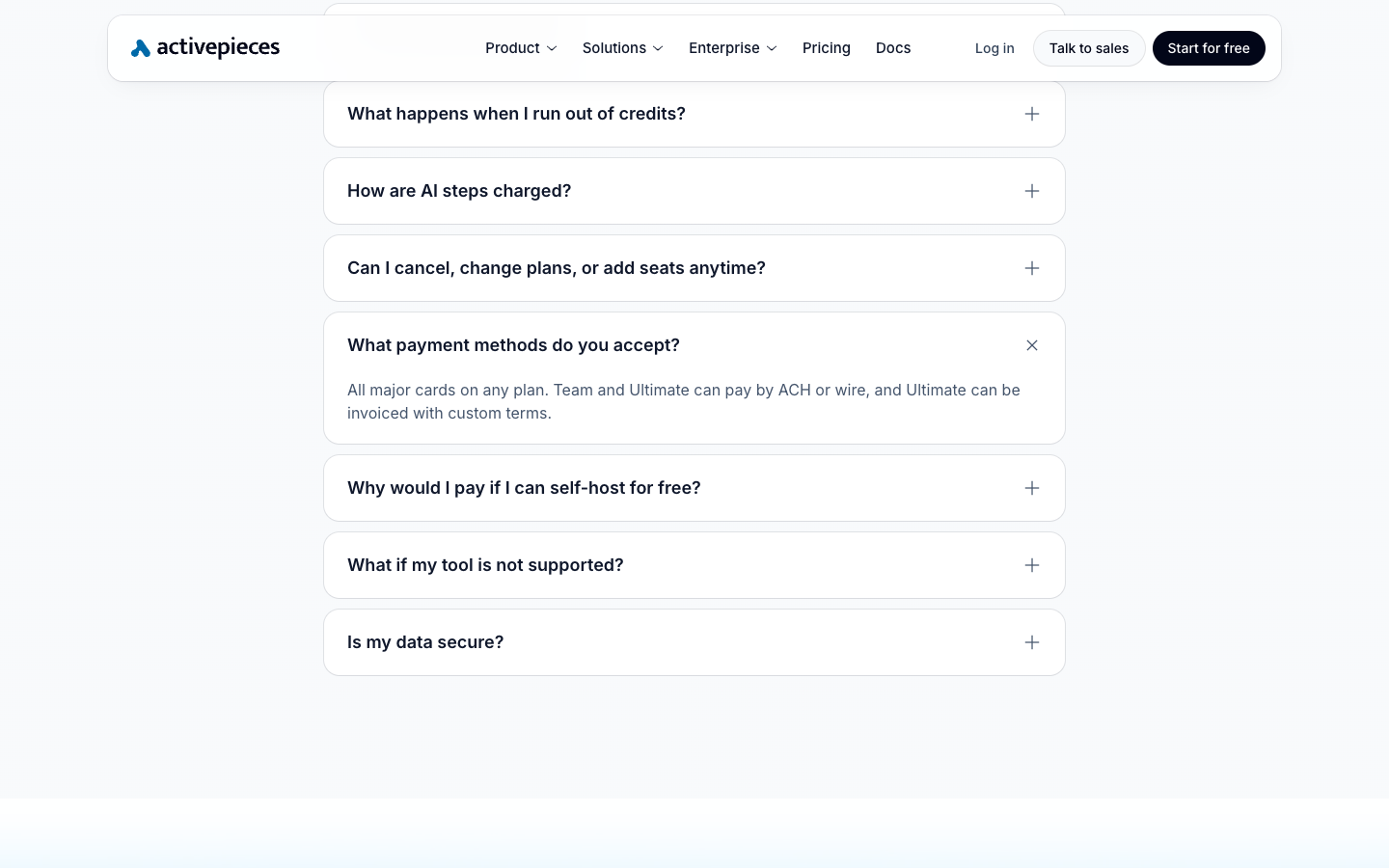
Workflows built by StartAutomate, with names blurred. The Activepieces shot shows a sample flow, since we only build there for clients who already use it.
Company and compliance
Company, hosting and compliance
| Feature | Activepieces |
|---|---|
| Founded | 2022 (Y Combinator, Summer 2022)[1] |
| Headquarters | San Francisco. Cloud runs in Frankfurt[1, 5] |
| Company and track record | Y Combinator backed[1] |
| Self-hosting | Yes: Docker, Docker Compose, Helm, air-gapped on Enterprise[2, 15] |
| Source code | MIT core, commercial license for the ee folder[6] |
| Compliance | Security page says SOC 2 Type 2. A Nov 2026 Activepieces blog says it is in progress[5, 8] |
| SSO | From Team ($200/mo)[2] |
Compare
Compare Activepieces
Each comparison covers cost, features, performance and which one to pick.



Sources
Sources
Every source was read on the date shown. 15 sources in total.
- Activepieces company profile. Y Combinator. Accessed 28 November 2026.
- Pricing. Activepieces. Accessed 28 November 2026.
- Workflow builder. Activepieces. Accessed 28 November 2026.
- Integrations. Activepieces. Accessed 28 November 2026.
- Security. Activepieces. Accessed 28 November 2026.
- LICENSE. GitHub. Accessed 28 November 2026.
- Limits. Activepieces Docs. Accessed 28 November 2026.
- Activepieces credits, pricing and usage (2026 guide). Activepieces. Accessed 28 November 2026.
- Versioning. Activepieces Docs. Accessed 28 November 2026.
- Changelog. Activepieces Docs. Accessed 28 November 2026.
- MCP. Activepieces. Accessed 28 November 2026.
- Activepieces reviews. G2. Accessed 28 November 2026. Read from a search snippet, G2 blocked the direct request.
- Activepieces reviews. Trustpilot. Accessed 28 November 2026.
- StartAutomate client work, 2019 to 2026. StartAutomate, first-hand data.
- Production setup. Activepieces Docs. Accessed 28 November 2026.